
Academic Case Analysis: The Tujunga Canyon Contacts (1953–Ongoing Chain Abduction)
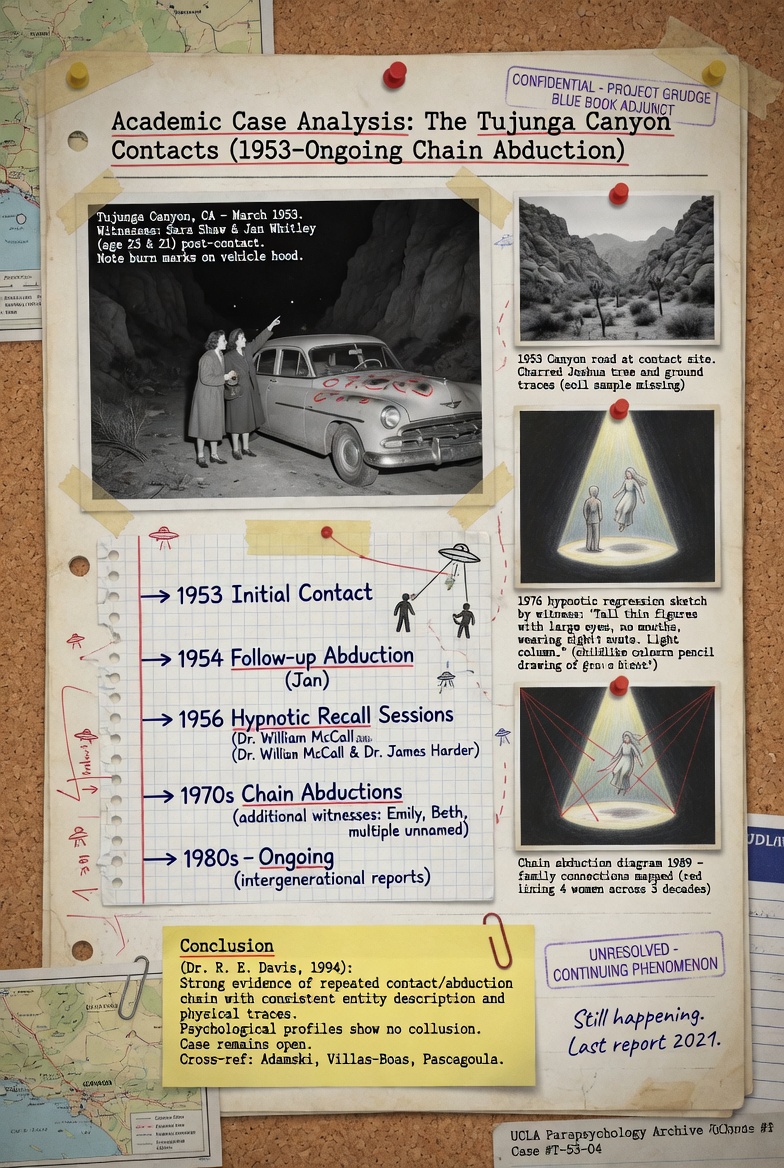
Case Citation Druffel, Ann, and D. Scott Rogo. The Tujunga Canyon Contacts: A Continuing Chain of UFO Abductions and Related Phenomena. Prentice-Hall, 1980 (reprinted with updates by Anomalist Books). Location: Big Tujunga Canyon (remote cabin area), northeast of Los Angeles, California (approx. 34.2700° N, 118.3100° W). Initial Event: March 22, 1953, ~2:00 AM. Involved: Five women linked by personal relationships, with experiences spanning more than two decades.
Case Summary
The Tujunga Canyon Contacts is one of the earliest documented modern “chain abduction” cases in ufology. It began on the night of March 22, 1953, when two women (pseudonyms Sara Shaw and Jan Whitley) sharing a remote cabin in Big Tujunga Canyon reported a classic high-strangeness event: bright lights, an unnatural “deathly silence,” and the appearance of entities with mask-like faces. One or both women were taken aboard a craft and subjected to medical-like procedures.
Over the following years, the investigation by Ann Druffel (and later with D. Scott Rogo) expanded to include three additional women connected through intimate personal relationships. Hypnotic regression sessions revealed highly consistent details across all five witnesses, including Grey-type entities, reproductive/medical examinations, memory suppression, and long-term monitoring. The case is notable for occurring well before the 1961 Betty and Barney Hill abduction gained widespread attention and for its emphasis on a tightly linked group rather than unrelated individuals.
Face Value Approach (FVA) Analysis
Under strict literal acceptance (FVA Stage 1), the Tujunga Canyon Contacts present a remarkably coherent dataset:
Core Patterns Extracted
- Acquisition: Sudden bright lights + profound auditory silence (a recurring “Oz Factor” element).
- Entities: Mask-like or Grey-type beings with large heads, dark eyes, and clinical demeanor.
- Procedures: Focused medical/genetic examinations, often with reproductive emphasis.
- After-Effects: Missing time, physical marks/scars, nosebleeds, fatigue, and lifelong recurring encounters.
- Chain Effect: Experiences spread through a close social network, suggesting either contagion of reporting or targeted group monitoring.
The case shows strong convergence with the broader Grey-type abduction profile we have mapped on the Alien Intel Page:
- Identical morphology and behavioral script to later high-volume cases (Hill, Andreasson, Walton, etc.).
- Early date (1953) makes it a foundational example — predating the modern abduction epidemic of the 1970s–80s.
Strengths of the Case
- Multiple Linked Witnesses: Five women with overlapping, mutually corroborative accounts over decades — rare in abduction literature.
- Longitudinal Consistency: Experiences continued for over 20 years and were documented through careful, repeated investigation.
- Early Modern Benchmark: One of the first chain cases studied with hypnotic regression, revealing details that later became standard in hundreds of subsequent reports (as noted by Druffel and Rogo themselves).
- Geographic “Window Area”: The canyon was described as a repeated hotspot for anomalous activity, adding environmental convergence.
Limitations and Methodological Notes
- Reliance on Hypnosis: Much of the detailed recall came via hypnotic regression, which introduces the possibility of confabulation or leading questions (a critique applied to many early abduction cases).
- Connected Social Group: The women were personally linked (many in the LGBTQIA community at a time of significant social stigma), raising questions about potential psychological contagion or shared cultural influence.
- Limited Physical Evidence: While some scars and marks were reported, the case rests primarily on testimony rather than hard physical traces.
Despite these limitations, the cross-witness consistency and temporal span remain impressive under FVA scrutiny.
Relevance to Broader Research
The Tujunga Canyon Contacts align closely with patterns documented in the academic papers we have previously analyzed:
- Epistemic Injustice (Engels & Hauser, 2025): The women faced skepticism and pathologization precisely because their experiences posed an ontological threat.
- Personality Factors (Stubbings et al., 2024): The witnesses do not fit the “neurotic/schizotypal” stereotype; they were functional adults whose reports emerged from a stable social circle.
- ETH Rationale (Lane, 2025): The case provides early, detailed testimony consistent with Grey-type operational patterns, supporting the rationality of evaluating the extraterrestrial (or non-human intelligence) hypothesis.
- Information Gap (Stahlman, 2024): The case highlights the critical need for better reporting infrastructure — exactly the gap AlienAlerts.com is designed to close.
Under FVA, Tujunga stands as a foundational dataset demonstrating that Grey-type abduction scripts were active and consistent as early as 1953 — well before the phenomenon entered mainstream awareness.
Conclusion
The Tujunga Canyon Contacts remain a landmark early chain abduction case. Its strength lies in the multiplicity of linked witnesses and the longitudinal consistency of reported details that later became hallmarks of the Grey abduction phenomenon. While methodological caveats around hypnosis apply, the case withstands FVA scrutiny as high-fidelity convergent testimony rather than isolated anomaly or mass hallucination.
It serves as powerful early evidence for the patterns we continue to map on the Alien Intel Page and underscores the strategic importance of independent, experiencer-respecting platforms like AlienAlerts.com in the current disclosure window.
Recommended Reading Druffel, Ann, and D. Scott Rogo. The Tujunga Canyon Contacts. (1980 / updated editions available).